5 Minute Workshops

Workshop 35Track: Build Better SystemsTime: About 5 minutesFor: Real estate agents

How to Tell Which Compelling Reasons Get the Best Response

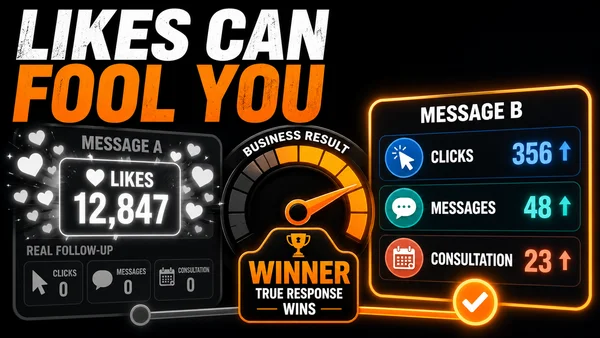
Some Compelling Reasons will connect with prospects more than others. The problem is that the strongest message isn’t always the one that gets the most likes.

A useful response might be a click, reply, direct message, saved post, consultation request, or real conversation. Once you know which response matters, you can see which Compelling Reasons deserve more attention.

01By The End Of This Workshop

You’ll create a simple way to track which Compelling Reasons produce the most meaningful response.

02What You'll Learn

  • Why likes alone can give you the wrong answer
  • How to choose one meaningful response to track
  • How to compare your Compelling Reasons more fairly

03The Problem

It’s easy to judge a marketing message by the number of likes it gets. But a like doesn’t always show real interest.

One Compelling Reason might get twenty likes and no questions. Another might get six likes, two website clicks, and a message from a possible seller.

The second message produced less visible activity, but it created a better business response.

You can also get the wrong answer when one message is posted more often or shown to a larger audience. Twelve clicks from 1,000 views aren’t always better than ten clicks from 100 views.

If you don’t decide what counts before you compare results, the largest number can fool you.

04The Simple Lesson

Choose one meaningful response before you compare your Compelling Reasons.

The right response depends on the goal of the message. You might track:

  • Website clicks when you want prospects to learn more
  • Replies or direct messages when you want conversations
  • Consultation requests when you want appointments
  • Saves or shares when the message is meant to be useful and remembered

Then compare the same type of response across several Compelling Reasons.

Keep the audience, platform, posting schedule, and call to action as similar as you can. If one message receives far more views, compare the response rate instead of the raw total. Divide the meaningful responses by the number of views, then multiply by 100.

Don’t declare a winner after one post. A topic, image, timing change, or smaller audience can affect the result. Use each Compelling Reason more than once before deciding what the response tells you.

05Real Estate Example

An agent tests two Compelling Reasons in separate posts.

The first explains how the agent keeps sellers informed during every stage of the sale. It gets fifteen likes and one website click.

The second explains how the agent helps sellers prepare for important pricing decisions with clear local market facts. It gets nine likes, seven website clicks, and one consultation request.

The first post looks more popular at a glance. The second creates more of the response the agent wants.

That doesn’t mean the first Compelling Reason is weak. It means the second one has earned more testing and more frequent use.

06What This Means For Your Marketing

Your 12 Compelling Reasons To Do Business With You don’t need equal attention forever.

Response data can help you decide which messages should appear more often on your website, in emails, during follow-up, and in social content. It can also show which Compelling Reasons need clearer wording or better proof.

When one Compelling Reason is paired with a Virtually Branded Scene, Visual Social Proof can help the message get noticed. Spaced Repetition gives prospects more chances to see it, remember it, and respond.

The goal isn’t to remove every message that gets a slower response. The goal is to learn which messages deserve more use and which ones need another look.

075-Minute Action Step

Choose one meaningful response you want to track. Write it at the top of a simple message log.

Add these four items:

  • Compelling Reason used
  • Date and place it appeared
  • Number of views, if available
  • Number of meaningful responses

Start with your next post, email, or follow-up message. Use the same response signal for each Compelling Reason you test. After several uses, circle the two messages producing the best response and give them more opportunities to work.

Five minutes is the goal, not a cutoff. Take a little extra time if more research or thought will improve your result.

08Your Result

You now have a simple way to learn from real prospect behavior instead of guessing which Compelling Reasons work best.

09Put It To Work

Once you find the messages that create meaningful responses, make them easier for prospects to see and remember.

Pair your own website with your own 12 Compelling Reasons and 12 Virtually Branded Scenes. Then use Spaced Repetition to keep the strongest messages visible over time.